Creative interpretations of Eaton Canyon, its history, its species diversity, its landscape and its future as expressed in poetry, prose, photography, art and video. Submit your own Trail Magic HERE.
Gliding over floodwaters, a raven scans the horizon while another listens to the wind. None of their mocking deceits are of use now, just imagining dry ground, mountainside perches in dead trees, and all the carrion the rippling expanse will yield.
On a sloped mesa brushed by warm breezes and thick with poppies in bloom, yellow and orange, look to the red sun low over the blue water and remember, deep in the canyon, just past the gray boulders, the two black birds pecking and picking at the eyes and ears.
The most impeccable mimic courts mockery. To see and listen to the point of synesthesia may imply concord but also blind silence, silent blindness. Yet a void of sight and sound, opening, might allow audiovisuals to arrive and remain distinct.
Two circle back and observe, chattering and wing gesturing. They dip over a ridge. Returning, one carries a small bottle, which the bird drops to the road. The bottle breaks. The other lands, grabs a shard with its beak, takes off. The birds fly from view.
After a canyon walk at dusk, return to the car, get in, lock the doors, crack a window, switch off the interior light, tilt back the seat. Shrouded by heavily tinted glass, sink into the plush black upholstery. Breath slows. Eyes close. A raven peers into the darkness.
Robert Savino Oventile hikes Eaton Canyon regularly. His poetry has appeared in The New Delta Review, Upstairs at Duroc, and The Denver Quarterly. He is coauthor with Sandy Florian of Sophia Lethe Talks Doxodox Down (Atmosphere, 2021). Robert is the current Poet Laureate of Local News Pasadena.
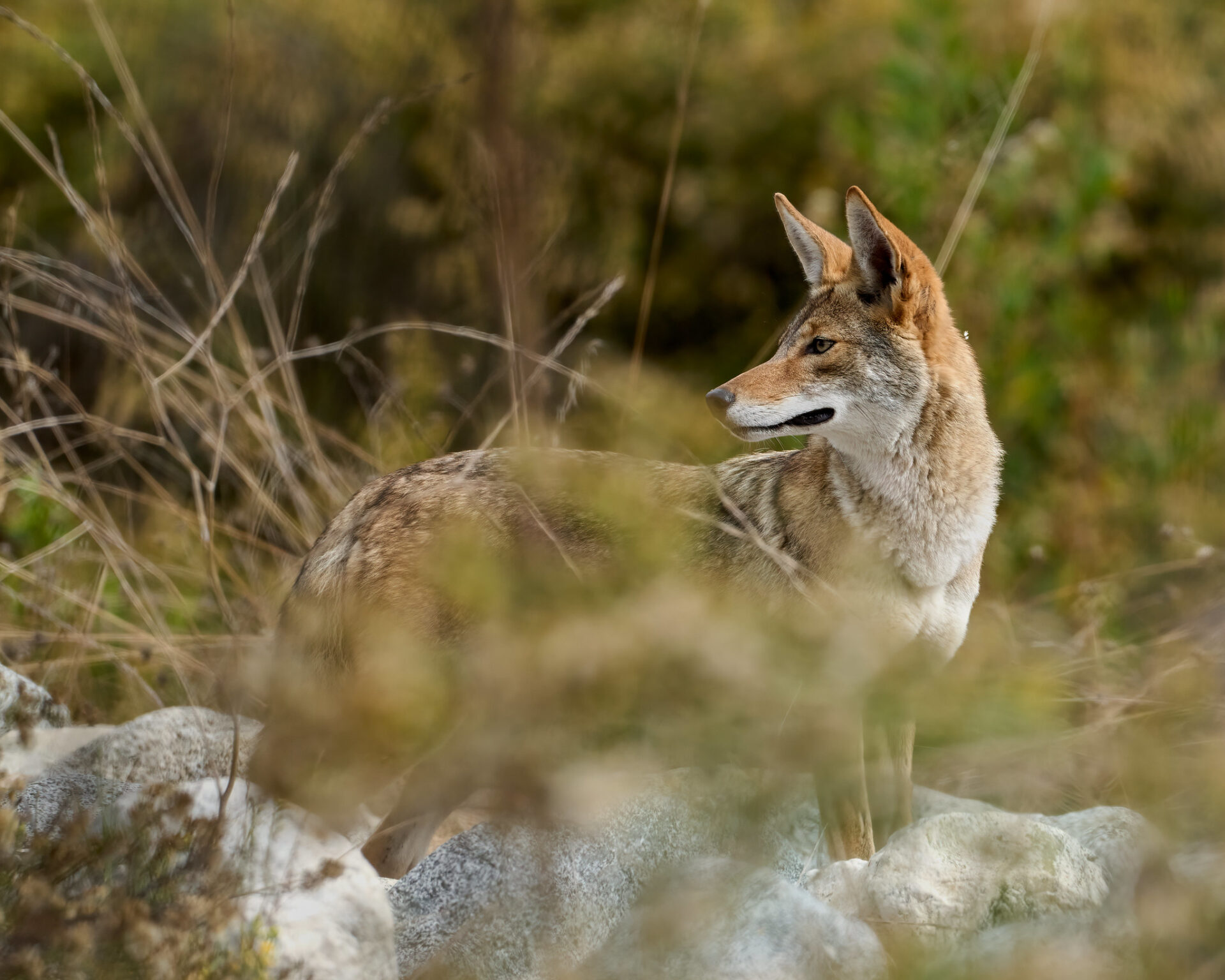
In early November 2023, I had a nice encounter with a beautiful female coyote.
While walking slowly and quietly in the Eaton Canyon wash, I caught movement in my peripheral vision; some animal slipping behind a Laurel Sumac shrub. It was only the briefest of glimpses at first. Something small, perhaps a Cottontail? Maybe a Quail? Seconds later, the shape of a Coyote emerged from behind a rocky berm about twenty yards away.
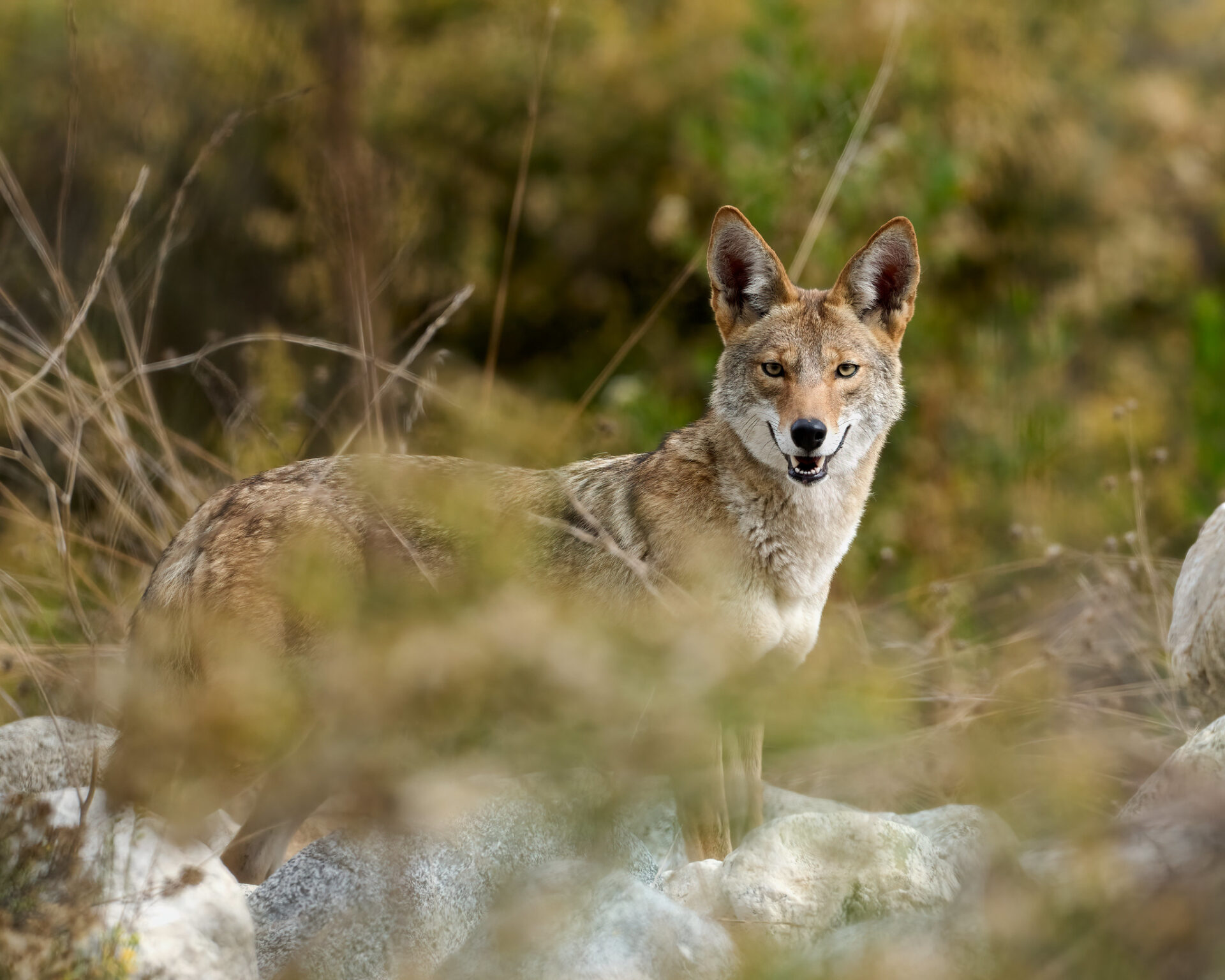
At first, she was looking away from me. I raised my camera and took a few shots. While doing so, she looked directly at me with cautious interest. Surprising me, she continued to look at me rather than fleeing, allowing me to get several nice photographs of her.
In my working life as an investigator for a state agency, I had a bit of training in interview and interrogation techniques that involve the study of how humans use and instinctively interpret non-verbal communication (body language, eye contact, facial expressions, etc.). Whether we are aware of it or not, we (humans) are all expert in reading these communication clues as we deal with others.
It is believed that language – our words – only communicate thirty or forty percent of the information transmitted during our interaction with others. The remaining percentage is transmitted and received somewhat unconsciously via non-verbal cues.
Our mammalian cousins – especially predators like canines and felines – are also expert in communicating non-vocally. Body language, eye contact, the display of teeth, bristling fur, tail posture and movement, etc., are all extremely important communication devices for them. Unfortunately, our human non-verbal forms of communication don’t necessarily transmit the same information to animals and vice-versa.
For instance, when we meet another person, it’s polite to make eye-contact (just not too long) and to bare our teeth in a pleasant smile. For dogs and cats, especially their wild cousins, direct eye contact is threatening, as is a display of teeth. If you have a pet dog or cat you’re likely very well aware of the subtleties of their non-verbal communication and none of this will be news to you. If you’re not otherwise aware of this phenomenon and find it interesting, there are numerous studies and information to be found. Google “Non-verbal communication” and/or the term “kinesics” for some interesting reading.
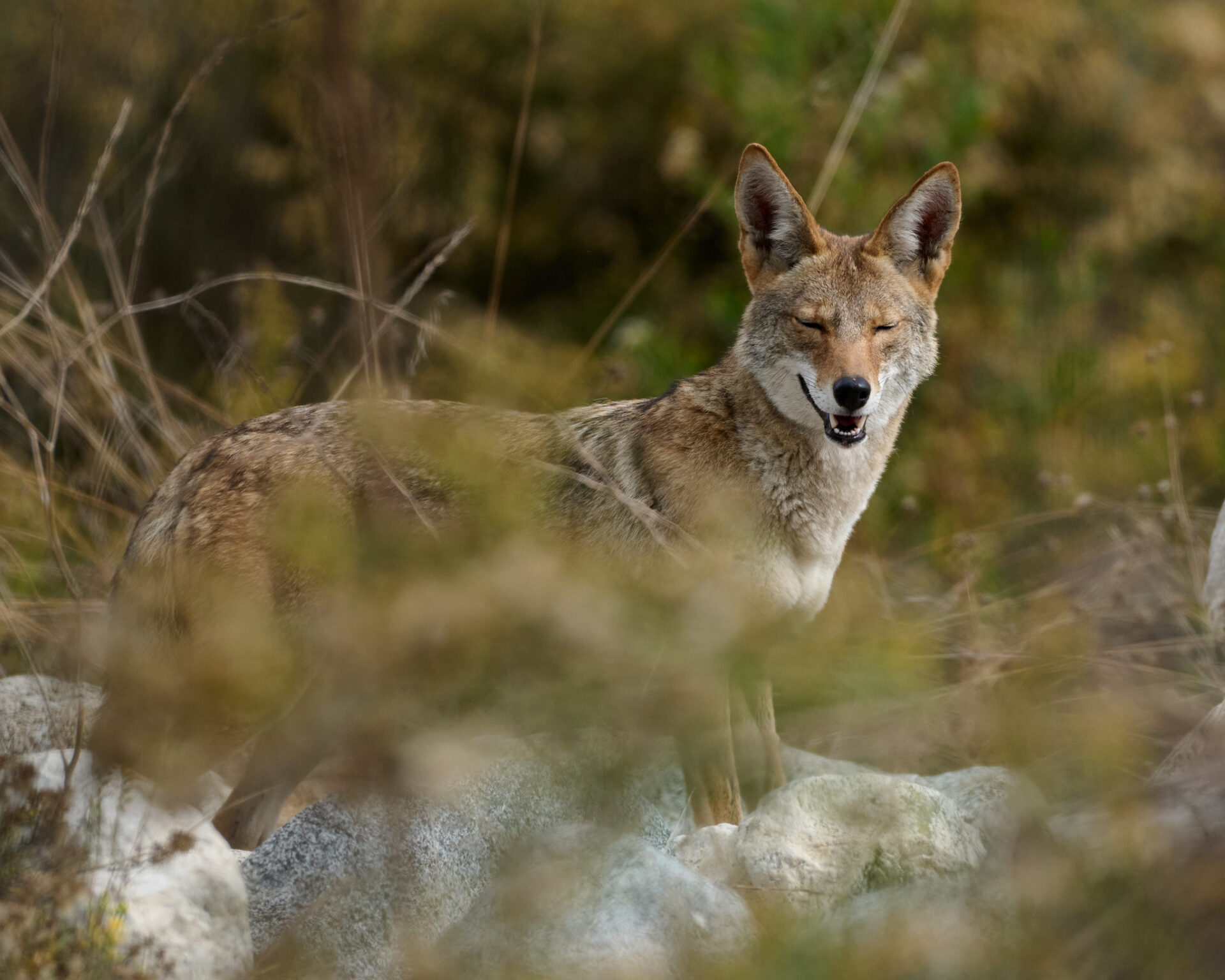
Being interested in this subject, when engaged in wildlife photography or simply encountering mammals such as coyotes or bobcats (even domesticated dogs and cats), I try using body language and facial expressions to communicate that I am not a threat in the hope of prolonging the encounter. I do this by making brief eye contact with the animal, then blink my eyes slowly and at length before looking down and away. I understand this to be a signal of non-aggression – a sign of trust, if you will – that these animals seem to understand. As in: “I see you and I am not a threat to you and I’m not afraid of you.” This seems to put the animal at ease somewhat, allowing me better photo opportunities.
When trying to photograph prey animals such as birds, deer, rabbits, etc., we can also increase our chances of getting a better view or photographs, by not looking directly at them and sort of approaching in a side-long fashion as if we are unaware of their presence.
Prey animals are almost always cryptically colored and will often rely on their camouflage if they believe you haven’t seen them. The trick is not to behave like a predator. They already know you are there. Don’t try to sneak up on them. Behave as if you don’t see them and aren’t stalking them.
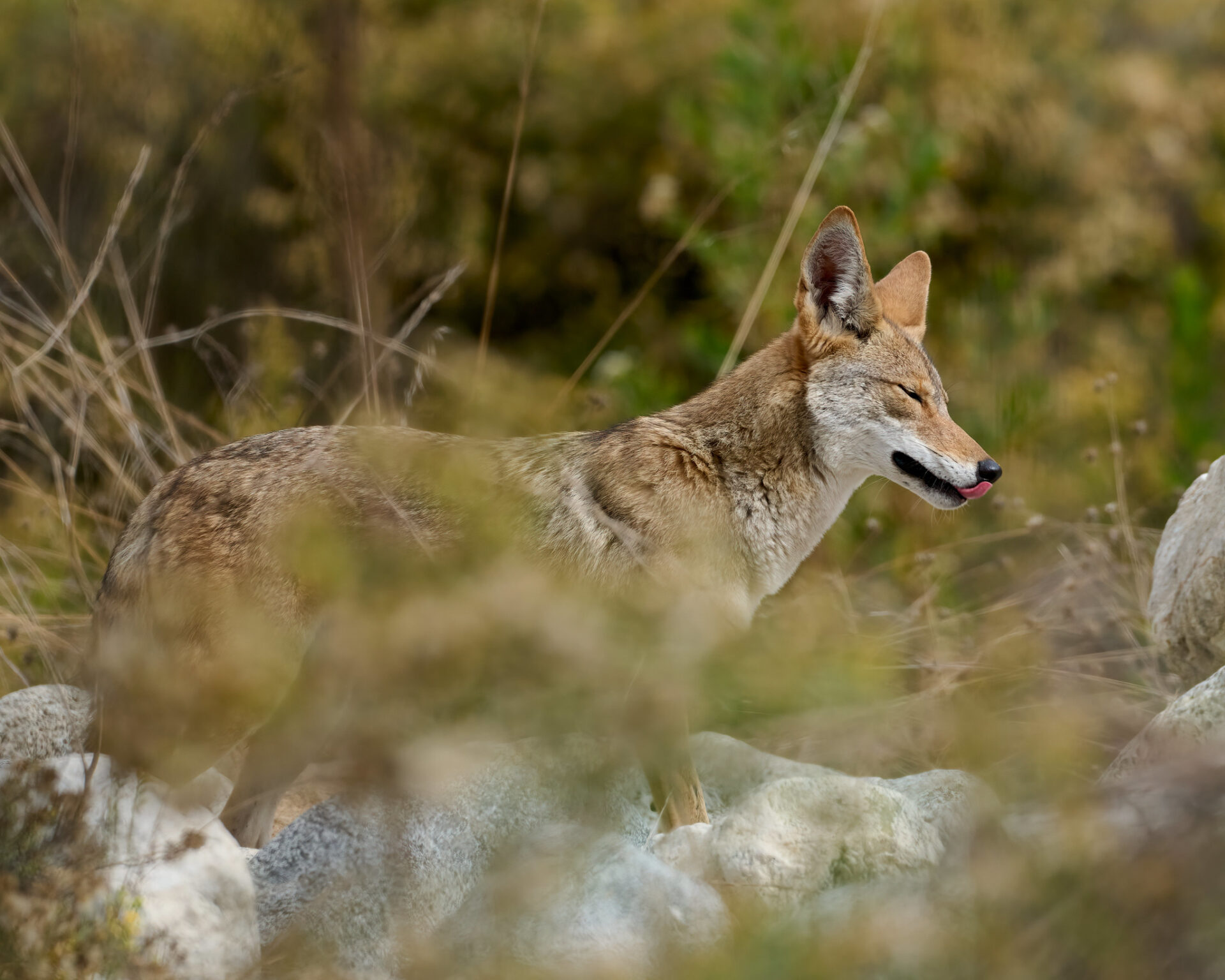
After taking several photos of this beautiful coyote, I lowered my camera and made eye contact with her. I then closed my eyes in a prolonged/slow blink, slowly turning my head slightly away. She almost immediately reciprocated, closing her eyes, at length. As she did so, I shouldered my camera once again and captured a sequence of images as she turned her head with eyes closed and slowly walked away.
A silent milling black cloud ravenously at a beached whale carcass, crops filling to the point of balking flight, a rare feast, an echo of what had been common tableaux when mammoths fattened on grass and fell to old age or saber-toothed cats or obsidian points.
A few decades back, in the canyon, conservationists found old shell fragments where “the General” had hatched now over a century ago, so named by ornithologists, who took him to the Willamette Valley then to an east coast zoo, where he died young.
Return. High in the canyon, quiet pools below the upper falls await the shadow of broad wings and again would host the image of soaring, however briefly. Return, and though homecoming entangles two species, their gifts remain distinct.
To each a number, a name, a tag, a tracker, an online profile, a genealogy, a list of offspring, biological and foster, a relationship status, and if so with whom, a bio, a hatch date and location, a death date eventually, a dataset augmenting in the cloud.
With a cobalt sky above, the San Gabriels below, and San Gorgonio to the east capped white, ride a thermal, turn, turn, sight the Mojave’s khaki and the Pacific’s blue, then plunge down toward some crows in the canyon circling a patch of green.
Robert Savino Oventile hikes Eaton Canyon regularly. His poetry has appeared in The New Delta Review, Upstairs at Duroc, and The Denver Quarterly. He is coauthor with Sandy Florian of Sophia Lethe Talks Doxodox Down (Atmosphere, 2021). Robert is the current Poet Laureate of Local News Pasadena.