Susan Hopkins

Susan Hopkins is a Certified California Naturalist, a docent for the Eaton Canyon Nature Center and a docent naturalist for the Tejon Ranch Conservancy. She is a correspondent for regional nature publications including The Wrentit and Paw Prints. Susan is “squirrelbait” on www.iNaturalist.org where she administers the Eaton Canyon Biodiversity Project.

A group of people sitting on top of a mountain

Caltech Volunteers Remove a Half Ton of Invasive and Non-Native Plants

Saturday May 20th was the first Conservation Day in Eaton Canyon since the start of the pandemic. Conservation group leader Max Yasuda and a group of volunteers from the Caltech Y had fun removing half a ton of invasive and non-native mustards and thistles that clogged the trails.

You too can be part of the fun. The conservation group provides monthly and by-appointment opportunities to community members wishing to volunteer with the Eaton Canyon Nature Center. These opportunities will specifically entail conservation efforts within the park such as weed removal, tree planting and maintenance of native plants. The group accepts sign-ups from the public at https://tinyurl.com/eatoncanyonconservation.


Caltech Volunteers Remove a Half Ton of Invasive and Non-Native Plants Read More »

A close up of a flower garden

Common Names in Mexico for Eaton Canyon Plants & Animals

Common name (Binominal nomenclature)Known variously in Mexico
California Buckwheat (Eriogonum fasciculatum)Alforfon, Flor de borrego
Cochineal (Dactylopius)Cochinilla, Cochinilla grana
California Quail (Callipepla californica)Cordoniz, Codorniz Californiana, Codorniz de California
Coast Live Oak (Quercus agrifolia)Encino de la costa, Encino de California, Encino verde
California Dodder (Cuscuta californica)Grenas, Fideo, Cabellos de ángel
Yerba Santa (Eriodictyon crassifolium)Hierba santa, Hierba santa de hoja gruesa
Mule Fat (Baccharis salcifolia)Huatamote, Jarrillas, Azumiate, Chilca, Batamote
Laurel Sumac (Malosma laurina)Lentisco
Shortpod Mustard (Hirschfeldia incana)Mostazilla, Rabaniza amarilla
Poison Oak (Toxiodendron diversolobum)Roble venemoso del Pacifico
Sugarbush (Rhus ovata)Saladitos, Arbusto de azúcar
Black Sage (Salvia melifera)Salvia de miel
White Sage (Salvia apiana)Salvia real, Salvia blanca
Toyon (Heteromeles arbutifolia)Tollon
Chaparral Yucca (Hesperroyucca whipplei)Yuca de chaparral
Western Sycamore (Platanus racemosa)Sicomoro, Aliso
Prickly Pear Cactus (Opuntia)Nopal, Cactus de higo, Xoconostles
Translated by Brenda Kyle, Arboretum Amy & Susan Hopkins
Toyon photo: © Susan Hopkins

Common Names in Mexico for Eaton Canyon Plants & Animals Read More »

Large sinkhole with a person standing in it.

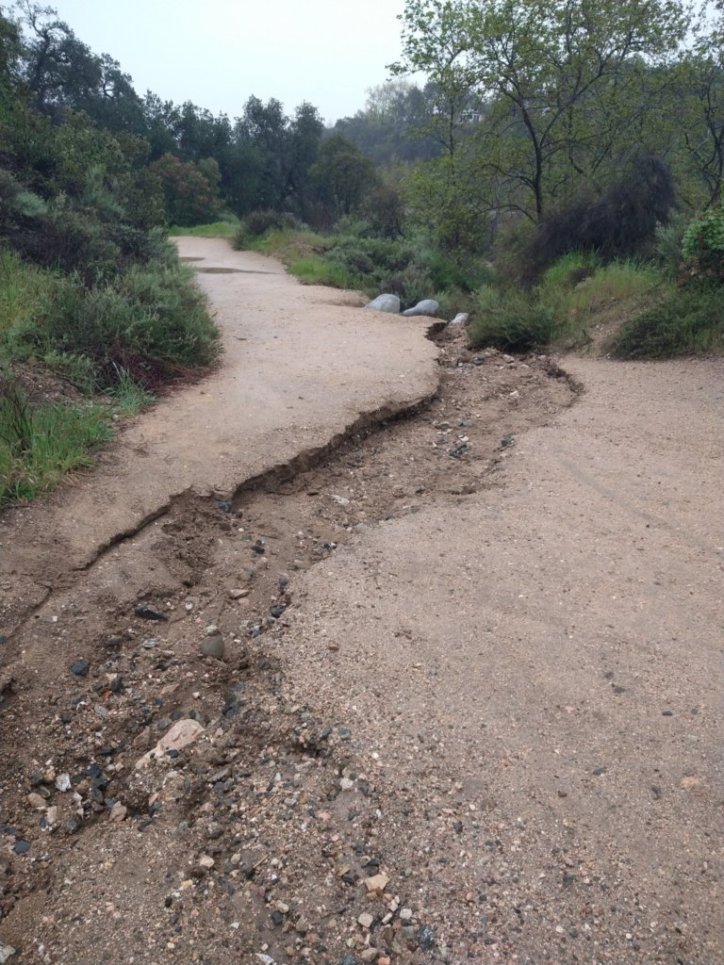
Eaton Canyon Trail Damage Following Recent Storms

The 2023 water year in Southern California has become one of the wettest years of the 21st century. Over 30″ of precipitation has fallen in the canyon so far, with more on the way. All of this heavy rain has taken its toll on Eaton Canyon’s popular trails, with several sections of the main Eaton Canyon Trail being damaged. All of the damaged sections are north of the Eaton Canyon Natural Area Park boundary in other government jurisdictions.


A storm in December 2021 severely damaged a section of the Walnut Canyon Trail, allowing huge amounts of water to flow into a smaller canyon that normally wouldn’t see as much flow. This water drains on to the main Eaton Canyon Trail which was severely damaged during the January 10, 2023 storm. Subsequent storms have made the situation worse. The location of this trail rut is 34.18611139942555, -118.1007962997867

The 2005 flash flood that struck Eaton Canyon was one of the largest floods in the past century. Part of the main trail was washed out, and a ~25′ dirt and sandstone wall that was sculpted by this flood remains there to this day. Too much rain this past winter caused part of this sandstone wall to collapse on the main Eaton Canyon Trail during the January 10, 2023 storm.  About 80% of the trail was blocked by mud. It is still safe for hikers to bypass, but it is not possible for emergency vehicles to circumvent. The location of this mudslide is 34.18989461871701, -118.10316768066636

Lorraine Lazarus, Eaton Canyon Natural Area’s Superintendent, inspected damage to the trail on Monday, February 27th. A work order has been submitted and the county is planning to repair the trail rut following the current storm series. There has been no update on the mudslide further up the trail.

Photos: @ Edgar McGregor@ Susan Hopkins 


Eaton Canyon Trail Damage Following Recent Storms Read More »

Scroll to Top